Education has spent generations recording the outcomes of learning while much of the evidence of growth disappears, unrecognized. We now have the tools to change that. The challenge before us is to build a trusted evidence infrastructure that recognizes learning wherever it occurs, connects it over time, and turns it into continuous support for every learner.
Imagine two students.
The first student reads the text and studies for an exam in the last few hours, earns an A, and moves on to the next topic.
The second student struggles at first. She asks questions, works through problems with classmates, seeks feedback from her instructor, uses an AI tutor to practice difficult concepts, revises her understanding several times, and gradually builds confidence. When the exam arrives, she earns a B.
Which student learned more?
Most educators would hesitate to answer that question based on the exam score alone. But we know full well that learning is much more than a final grade. It is a process of questioning, practicing, receiving feedback, reflecting, making mistakes, and refining understanding over time.
Yet we also know that our educational systems are principally designed to remember and record the outcome, not the journey. We record exam scores, assignment grades, and course completions, while much of the evidence of learning—the conversations, revisions, and moments of insight that shape understanding—simply disappears.
The problem isn't that educators misunderstand learning. We've known for decades that learning is continuous and dynamic. Learning scientists have spent decades studying how people learn best. We know that learning is strengthened through practice, feedback, collaboration, reflection, and timely support. We also know that students learn at different rates and often take different paths toward mastery.
The problem is that our educational systems have been built around logistical and systemic constraints, not learning. When a single instructor is responsible for teaching hundreds of students, it simply isn't possible to observe every question, every misconception, every revision, and every breakthrough. Instead, we rely on assignments, exams, and final grades as practical summaries of learning.
For generations, that has made sense. Those measures are efficient, scalable, and often the best evidence available.
But, students learn in many different places. They discuss ideas with classmates, practice with AI tutors, complete interactive simulations, receive feedback from instructors, collaborate on projects, and apply new knowledge in the workplace. Every one of these experiences provides evidence of learning. Yet most of that evidence is never captured, never connected, and never used to support future learning. Emerging AI technologies can provide the missing link to capture and connect the scattered evidence of learning occurring across classrooms, tutors, and digital platforms.
Rethinking Evidence Through AI
Advances in artificial intelligence give us an opportunity to rethink how we capture, understand, and support that continuous process. It is not simply about replacing one type of assessment with another. It reflects a transition from a time-based educational model to an ecosystem that recognizes learning as mastery-based, continuous, and supported by portable evidence collected across multiple personalized learning experiences.
| Dimension | Legacy Education System
| AI-Enabled Ecosystem
|
Progression
| Time-based (Seat time dictates advancement) | Mastery-based (Advancement occurs when skill is achieved) |
Assessment
| Episodic (Isolated, high-stakes exams) | Continuous (Seamless, invisible "stealth" assessment) |
Structure
| Fixed course sequences (Rigid prerequisites) | Dynamic competency networks (Adaptive, personalized paths) |
Scope
| Disconnected, discrete courses | Portable, multi-decade learner records (Lifelong proof) |
Doing so requires us to step back and examine the assumptions on which our educational systems have been built. Much of higher education was designed for a world in which learning occurred primarily in classrooms, students progressed together through fixed courses, and assessment happened at discrete points in time. Those assumptions shaped everything—from how students advanced through a curriculum to how learning was documented and credentialed.
Now, artificial intelligence, combined with advances in a host of other technologies, raise the opportunity to rethink how we capture, understand, and support continuous learning processes. Rather than simply automating existing assessments, AI can help us recognize learning as it unfolds. It allows us to collect rich evidence, provide timely feedback, and develop a more complete picture of how learners grow over time.
Imagine if we could bring together evidence from all the places where learning occurs—not into one giant database, but into an ecosystem that helps learners, educators, and institutions better understand growth over time.
That evidence might come from a learning management system, an AI tutor, a classroom discussion, a collaborative project, a digital simulation, or even workplace learning. Individually, each experience provides only a small glimpse of what a learner knows and can do. Together, they tell a much richer story.
The challenge is that these experiences are scattered across different platforms, use different formats, and capture different kinds of information with different temporal structures. Some record grades, others capture conversations, while still others document how learners solve problems or collaborate with teammates. If learning can occur across so many environments and over many years, how do we collect, interpret, and preserve meaningful evidence of that learning? How do we do so in ways that are scientifically sound, technically robust, ethically responsible, and worthy of learners' trust?
Building an Infrastructure for Continuous Assessment
Answering these questions requires more than a single technological breakthrough. It requires bringing together decades of advances across learning sciences, psychometrics, educational measurement, artificial intelligence, learning analytics, human-computer interaction, data infrastructure, and privacy-preserving technologies. Each of these fields contributes an essential capability. We need ways to collect evidence from diverse learning environments, organize it into meaningful records, interpret rich learner interactions, estimate developing competencies using rigorous measurement models, represent learning as dynamic profiles that evolve over time, and ensure that privacy, transparency, learner agency, and responsible governance are embedded throughout the system. Individually, none of these capabilities is sufficient. Together, they provide the foundation for an evidence infrastructure that can support continuous learning across contexts and throughout a learner's lifetime.
This challenge motivated my colleagues and me to develop the AI-Mediated Continuous Assessment Infrastructure (AIM-CAI), an architectural framework that integrates these complementary capabilities into a coherent evidence infrastructure for continuous learning. The figure below illustrates the major components of that architecture.
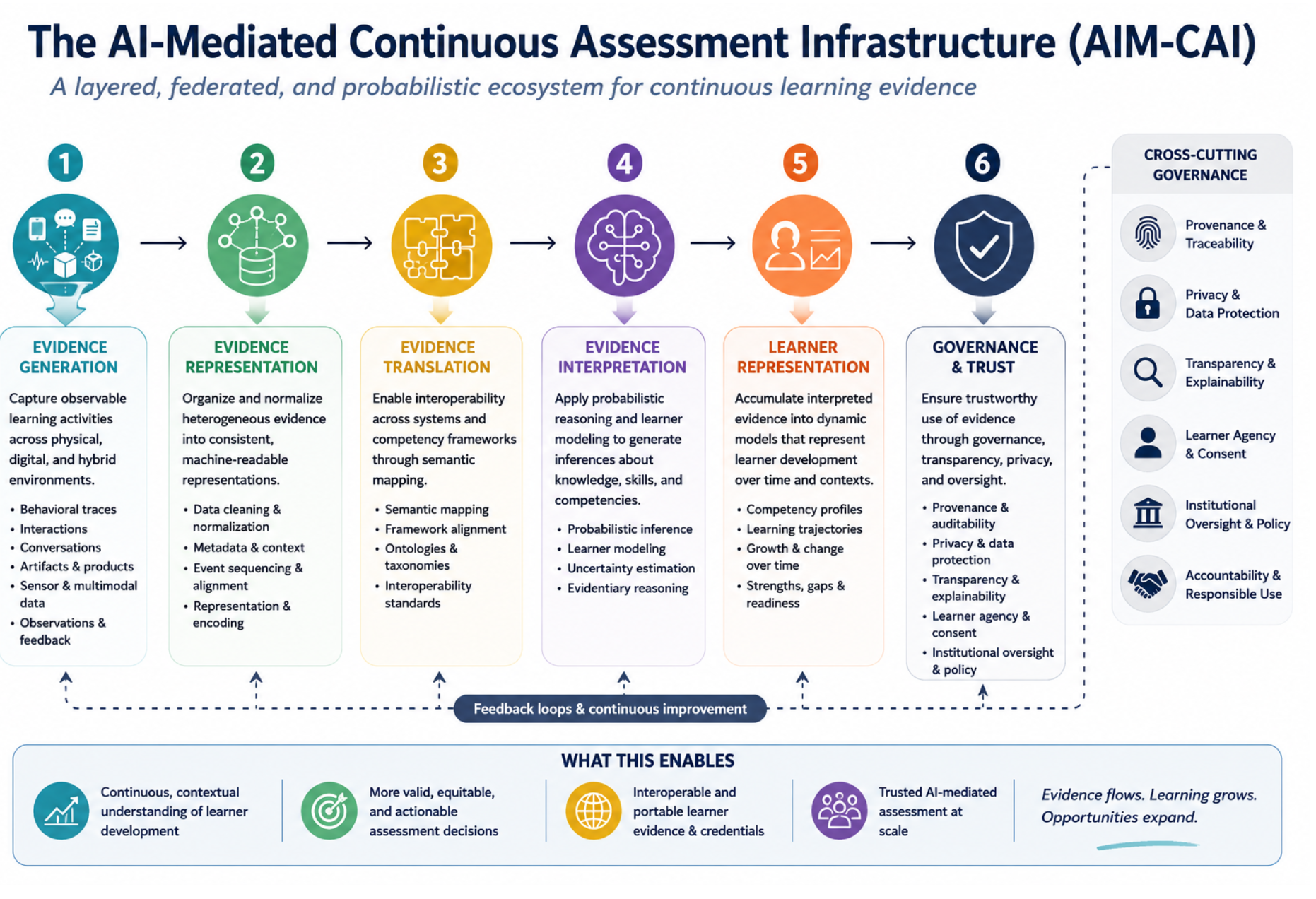
While each component addresses a different challenge, together they serve a common purpose: creating an evidence infrastructure that reflects how learning actually happens. Rather than treating learning as a series of isolated events, AIM-CAI recognizes learning as continuous, distributed, and evolving over time. It is designed to connect evidence across learning experiences while preserving the scientific rigor, interoperability, and trust required to make that evidence meaningful.
Underlying this work is a commitment to AI stewardship, recognizing that educational AI should support learning while respecting learner agency, transparency, privacy, and trust.
Our focus is building a trusted evidence infrastructure that allows learning to be recognized, connected, and carried forward across educational settings and throughout a learner's lifetime. Achieving this vision brings together decades of advances in learning sciences, psychometrics, educational measurement, artificial intelligence, learning analytics, human-computer interaction, and data governance into a coherent foundation for the continuous learning era.
The ultimate goal is not just continuous assessment. It is continuous support—using trustworthy evidence, AI, and decades of advances across multiple fields to help every learner receive the right support at the right time, wherever learning occurs.
 Sign Up